
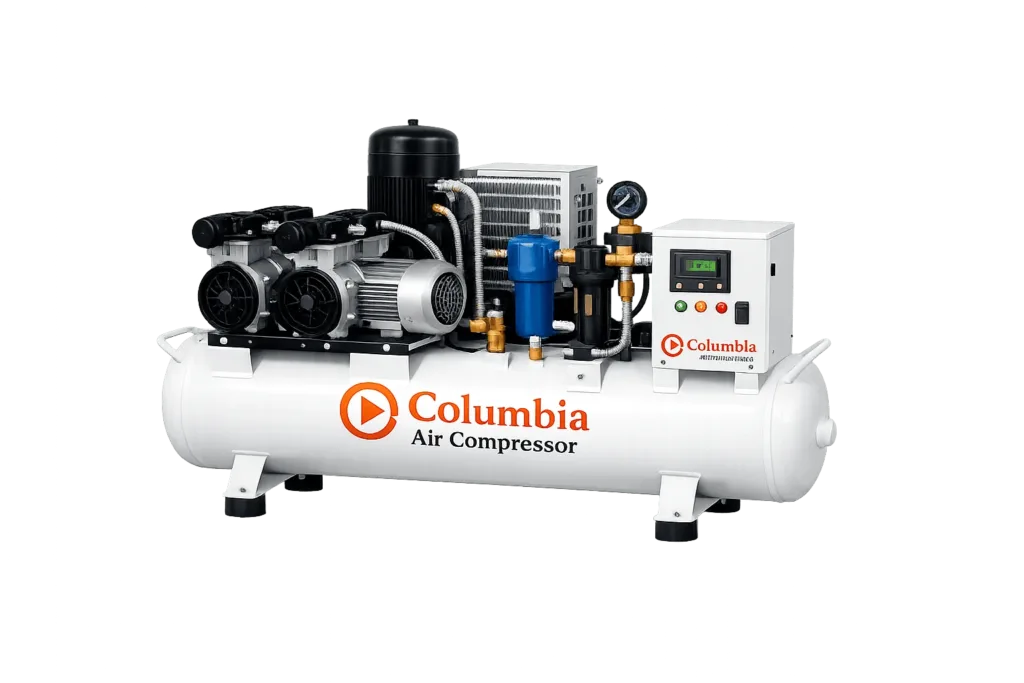
air compressor for laser cutting machine
Introduction
Choosing the right air compressor for laser cutting machine applications helps you get clean cuts, steady airflow, and smooth production. The right system supplies clean, dry compressed air to the cutter, removes molten material, and protects key parts.
Not every setup is suitable for this work. You need to check CFM, PSI/bar, duty cycle, air dryer, filters, and receiver tank. In this guide, you will learn how to choose a reliable compressed air supply for fiber laser, CO₂ laser, and industrial cutting needs.
What Is an Air Compressor for a Laser Cutting Machine?
An air compressor for a laser cutting machine is a system that supplies clean, dry, and stable compressed air to the cutting head. During the process, this setup works as an assist gas to move molten material, smoke, and debris away from the cut area.
Unlike a general workshop supply, this setup must deliver the correct pressure, airflow, and quality required by the equipment. A steady clean supply helps maintain accuracy and protects key parts such as the nozzle, cutting head, and protective lens.
How Does It Work With the Machine?
The system follows a simple path:
Compressor → Receiver Tank → Dryer & Filters → Pressure Regulator → Cutting Head
- The compressor creates the required supply.
- The receiver tank stores it and helps keep pressure stable.
- The dryer and filters remove moisture, oil particles, and dust.
- The pressure regulator controls delivery before it reaches the nozzle.
- The airflow exits through the nozzle and supports the cutting process.
This controlled flow clears melted material from the cut path and improves overall performance.
What Does a Compressor Do in Laser Cutting?
An air compressor supports several important functions:
- Removes molten material: Compressed air pushes melted metal away from the cutting area.
- Improves cut quality: Stable airflow helps produce cleaner edges with less dross.
- Protects laser components: Clean air helps prevent contamination of the nozzle, lens, and cutting head.
- Maintains consistent operation: Proper airflow reduces interruptions caused by pressure fluctuations.
Components of a Laser Cutting Compressed Air System
A complete compressed air system for laser cutting usually includes:
- Air compressor
- Air receiver tank
- Air dryer
- Moisture separator
- Air filters
- Pressure regulator
- Compressed air piping
Each component plays an important role in delivering reliable and clean air to the laser machine.
Choosing the right laser cutting air compressor depends on factors such as the laser type, required airflow, operating pressure, production hours, and air quality requirements.
Why Does a Laser Cutting Machine Need an Air Compressor?
A laser cutter needs a steady supply because the flow moves through the nozzle and clears molten material, smoke, and dust from the work area. This supply also works as assist gas, helping the beam cut more smoothly and reducing dross.
Removes Molten Material from the Cutting Area
During the process, the laser beam creates high heat and melts the material. Pressurized flow pushes this melted material away from the cut line.
Without enough airflow, slag can stay near the edge. This may lead to rough cuts, incomplete cutting, or poor edge finish.
Improves Cut Quality
A proper system helps maintain steady pressure and smooth airflow. This supports cleaner and more accurate results.
It can help reduce:
- Dross formation
- Rough edges
- Incomplete cuts
- Process interruptions
- Poor edge finish
For fiber systems and CO₂ cutters, the right supply improves consistency. This is important when working with sheet metal, stainless steel, carbon steel, aluminum, and other industrial materials.
Protects the Cutting Head and Nozzle
Clean and dry supply helps protect key parts such as the cutting head, nozzle, protective lens, valves, and lines.
If moisture, oil, or dust enters the system, it can dirty the lens or block the nozzle. This can lower accuracy and increase maintenance needs. That is why dryers, filters, moisture separators, and pressure regulators are often used.
Supports Stable Operation
Weak or unstable flow can cause pressure drops during work. When this happens, the machine may create poor cuts or stop working properly.
A suitable setup helps provide:
- Stable pressure
- Enough airflow
- Clean and dry supply
- Reliable performance
This helps reduce downtime and keeps production smooth.
Can Reduce Assist Gas Cost in Some Applications
In some jobs, this setup can reduce the need for nitrogen or oxygen. This may help lower operating cost.
However, it is not always the best choice for every material. The final gas choice depends on material type, thickness, speed, and required edge finish. For example, nitrogen may still be better when a clean, oxide-free edge is needed.
In short, the system helps remove molten material, improve cut quality, protect machine parts, and support stable performance.
How Does Compressed Air Work in Laser Cutting?
Compressed air works as an assist gas in laser cutting. The laser beam melts the material, and the compressed air blows the molten metal, smoke, and dust away from the cutting line.
The air follows this path:
Air Compressor → Dryer and Filters → Pressure Regulator → Laser Cutting Head → Nozzle → Cutting Area
When the air reaches the nozzle, it flows with the laser beam. This helps keep the cut area clean and improves cutting quality.
Compressed air helps to:
- Remove molten material
- Reduce dross
- Improve edge finish
- Clear smoke and debris
- Protect the nozzle and lens
- Keep cutting more stable
For best results, the air must be clean, dry, and supplied at stable pressure. Poor airflow or wet air can cause rough cuts, nozzle blockage, and lower cutting accuracy.
How Does Laser Cutting Work With Compressed Air?
Laser cutting uses a focused laser beam and compressed air to cut materials accurately.
The laser beam creates heat and melts the material, while compressed air works as an assist gas
to remove molten metal, smoke, and debris from the cutting area.
The process follows:
Laser Source → Cutting Head → Nozzle → Compressed Air → Material
- The laser beam melts the material at the cutting point.
- The cutting head controls the laser position and focus.
- The nozzle directs compressed air around the laser beam.
- The airflow removes molten material and improves cut quality.
Clean and stable compressed air helps reduce dross, protect the nozzle and lens,
and maintain consistent cutting performance.
What Specifications Does a Laser Cutting Compressor Need?
A laser cutting compressor must provide the right pressure, airflow, air quality, and duty cycle. These specifications help the laser cutting machine work smoothly and protect the cutting head, nozzle, and lens.
The main specifications to check are:
- Pressure: The compressor must supply the required PSI or bar at the laser machine inlet.
- Airflow: The compressor should provide enough CFM or FAD to keep cutting stable.
- Air quality: The air must be clean, dry, and filtered to prevent moisture, oil, and dust from entering the machine.
- Duty cycle: The compressor should match the machine’s working hours, especially for continuous laser cutting.
- Capacity: Do not choose by HP alone. Check the actual airflow at the required pressure.
A proper air compressor for a laser cutting machine helps prevent pressure drops, poor edge quality, dross, and machine downtime. Always check the laser machine manual before selecting the final compressor size.
What Type of Air Compressor Is Best for Laser Cutting?
The best air compressor for a laser cutting machine depends on the laser type, working hours, air demand, and air quality needs. For industrial laser cutting, a rotary screw compressor is usually the best choice because it gives steady airflow and stable pressure.
Small laser cutters may not need a large industrial compressor. In some cases, an oil-free compressor or piston compressor can work well for light-duty use.
Rotary Screw Compressor for Laser Cutting
A rotary screw compressor is suitable for fiber laser cutting machines and continuous production. It can run for long hours and supply stable compressed air to the cutting head.
This type is best for:
- Industrial laser cutting
- Fiber laser machines
- Sheet metal cutting workshops
- Long production shifts
- Multiple laser cutting machines
Oil-Free Compressor for Laser Cutting
An oil-free compressor is useful when clean air is very important. It helps reduce the risk of oil entering the air line, nozzle, or protective lens.
This option may suit:
- Small laser cutters
- CO₂ laser machines
- Laboratory use
- Low-demand cutting jobs
Piston Compressor for Laser Cutting
A piston compressor can be used for small CO₂ laser cutters or light-duty cutting work. It is usually lower in cost, but it may not be ideal for continuous laser cutting.
For long working hours, a piston compressor may create more pressure fluctuation and heat.
| Compressor Type | Best For | Main Benefit | Limitation |
|---|---|---|---|
| Rotary screw compressor | Industrial fiber laser cutting | Stable airflow and continuous duty | Higher initial cost |
| Oil-free compressor | Small or clean-air applications | Lower oil contamination risk | May not suit heavy production |
| Piston compressor | Small CO₂ laser or light use | Lower purchase cost | Not ideal for continuous operation |
Choose the laser cutting compressor based on required CFM, pressure, duty cycle, and air quality. Always check the laser machine manual before selecting the final compressor type.
Air Compressor Requirements by Laser Machine Type
Air needs change based on the system type, workload, material thickness, and daily use. A small CO₂ cutter may need only a compact supply, while an industrial setup needs stronger and more stable airflow.
The right setup should match the required pressure, CFM, duty cycle, and air quality.
Fiber System
A fiber system usually needs stable pressure, enough airflow, and clean, dry supply. This is important because fiber units are often used for metal work and long production hours.
A suitable setup should support:
- Stable airflow during operation
- Required pressure at the cutting head
- Clean and dry supply
- Proper filtration
- Long working hours
For industrial fiber work, a rotary screw unit is often a good choice because it can run continuously and keep steady delivery.
CO₂ Cutter
A CO₂ cutter may need less airflow than many fiber systems. Small units can often work with an oil-free unit, piston unit, or compact air pump, depending on the work type.
Larger CO₂ setups may need a stronger supply with a dryer and filters. This helps remove moisture, oil, and dust before the flow reaches the nozzle.
Desktop or Small Setup
A desktop cutter or small workshop unit usually needs low-pressure assist gas. The flow helps remove smoke, dust, and light debris from the work area.
Suitable options may include:
- Compact air pump
- Small oil-free unit
- Light-duty piston unit
This setup is best for hobby use, engraving, light work, and small production jobs.
Industrial Setup
An industrial setup needs a reliable supply because it may run for long shifts and handle thicker materials. The system must provide stable pressure and enough CFM for steady performance.
A complete setup may include:
- Rotary screw unit
- Receiver tank
- Dryer
- Coalescing filters
- Pressure regulator
- Proper piping
| System Type | Air Requirement | Suitable Option |
|---|---|---|
| Desktop CO₂ cutter | Low demand | Compact pump or oil-free unit |
| Small CO₂ cutter | Light to medium assist gas | Oil-free or piston unit |
| Fiber system | Stable pressure and clean supply | Rotary screw unit |
| Industrial setup | Continuous airflow and high reliability | Industrial screw unit |
| Multiple systems | Combined CFM capacity | Central supply system |
Always check the manufacturer’s manual before choosing the final setup. The correct choice depends on CFM, pressure, air quality, duty cycle, and future expansion needs.
Compressor Requirements by Cutting Material
The compressed air requirement for a laser cutting machine depends on the material being cut.
Different materials need different airflow, pressure, and air quality to achieve clean cuts and reduce defects.
The right compressor setup helps improve cutting performance in applications such as
stainless steel laser cutting, aluminum laser cutting,
mild steel cutting, and sheet metal fabrication.
| Material | Air Requirement | Important Factor |
|---|---|---|
| Mild Steel | Stable airflow and consistent pressure | Dross control and clean edge finish |
| Stainless Steel | Clean and dry compressed air | Better edge quality and reduced contamination |
| Aluminum | Higher airflow with stable pressure | Heat removal and cutting consistency |
| Copper | Proper pressure and controlled airflow | Reflective material cutting performance |
| Brass | Stable assist gas supply | Cutting accuracy and smooth edges |
Mild Steel Laser Cutting
Mild steel cutting requires stable airflow to remove molten metal from the cutting area.
A properly sized air compressor helps reduce dross formation and improves edge quality during sheet metal cutting.
Stainless Steel Laser Cutting
Stainless steel laser cutting requires clean and dry compressed air because contamination
from moisture or oil can affect the cutting head, nozzle, and final surface finish. Proper filtration helps maintain consistent results.
Aluminum Laser Cutting
Aluminum laser cutting often requires higher airflow because aluminum transfers heat quickly.
Stable compressed air helps remove molten material and supports better cutting performance.
Sheet Metal Fabrication Applications
In sheet metal fabrication, the compressor system should match the material type, thickness,
laser power, and production requirements. Using the correct airflow, pressure, dryer, and filtration system
helps maintain reliable laser cutting performance.
How to Size an Air Compressor for a Laser Cutting Machine?
To size an air compressor for a laser cutting machine, first check the laser machine manual. It will show the required air pressure and airflow. These are usually listed as PSI, bar, CFM, or FAD.
Do not choose a compressor only by HP. A good laser cutting compressor must give enough airflow, stable pressure, and clean dry air. The right size depends on laser type, laser power, nozzle size, material thickness, and daily working hours.
For a small CO₂ laser cutter, an oil-free or piston compressor may be enough. For a fiber laser cutting machine or industrial sheet metal cutting, a rotary screw compressor is usually better because it gives steady airflow for long hours.
Use this simple rule:
Required airflow = laser air demand + extra air use + safety margin
Always add around 20% to 30% extra capacity. This helps avoid pressure drops during cutting. Low air pressure can cause rough edges, dross, slow cutting, and poor cut quality.
Also, add the right air dryer, filters, receiver tank, and pressure regulator. These parts remove moisture, oil, and dust from the compressed air. Clean and dry air protects the laser nozzle, cutting head, and lens.
The best air compressor size for laser cutting is the one that matches your machine’s CFM, PSI/bar, duty cycle, and air quality needs.
Real Compressor Size Examples for Fiber Laser Cutting Machines
The correct compressor size for a laser cutting machine depends on laser power, cutting speed, material thickness, nozzle size, required pressure, and production hours. The examples below provide general guidance, but always check the laser manufacturer’s air requirements before selecting a compressor.
1kW Fiber Laser Cutting Machine Compressor Requirements
A 1kW fiber laser cutting machine usually requires a compact compressed air system for light to medium cutting applications. A small rotary screw compressor or high-quality oil-free compressor may be suitable depending on production needs.
Typical requirements may include:
- Pressure: Around 6–8 bar (87–116 PSI)
- Airflow: Approximately 10–20 CFM
- Suitable compressor: Small screw compressor or oil-free compressor
- Recommended accessories: Air dryer, moisture separator, and filters
For occasional or small workshop use, a smaller system may be enough. For continuous operation, choose a compressor with extra capacity to maintain stable airflow.
3kW Fiber Laser Cutting Machine Compressor Requirements
A 3kW fiber laser cutter generally requires a more stable compressed air supply because it is commonly used for thicker sheet metal and longer production cycles.
Typical requirements may include:
- Pressure: Around 7–10 bar (100–145 PSI)
- Airflow: Approximately 20–40 CFM
- Suitable compressor: Rotary screw compressor
- Recommended accessories: Receiver tank, refrigerated dryer, moisture separator, and multi-stage filtration
A rotary screw compressor is often preferred for 3kW fiber laser machines because it provides continuous airflow, stable pressure, and better performance during long cutting operations.
6kW+ Industrial Fiber Laser Cutting Machine Compressor Requirements
High-power fiber laser cutting machines used in industrial production require a reliable compressed air system with higher airflow capacity and continuous-duty operation.
Typical requirements may include:
- Pressure: Around 8–12 bar (116–174 PSI)
- Airflow: Approximately 40+ CFM depending on machine requirements
- Suitable compressor: Industrial rotary screw compressor or variable speed drive (VSD) compressor
- Recommended accessories: Large receiver tank, high-efficiency dryer, coalescing filters, particulate filters, and pressure regulation system
For heavy-duty laser cutting applications, an undersized compressor can cause pressure drops, unstable cutting performance, and increased dross. A properly sized industrial compressed air system helps maintain consistent cutting quality and reduces downtime.
Important Note Before Selecting a Compressor
These values are general examples only. The final compressor size should always match:
- Laser machine air consumption
- Required PSI/bar
- Cutting material and thickness
- Daily operating hours
- Air quality requirements
- Future production expansion
Choosing a compressor with a 20%–30% capacity margin helps maintain stable pressure and prevents performance issues during demanding cutting operations.
Air Compressor Size Guide for Laser Cutting
The right air compressor size for laser cutting depends on the laser type, material thickness, CFM, PSI/bar, and working hours. Do not select a compressor only by HP. Always check the laser machine manual first.
| Laser Application | Suitable Compressor Type | Best For |
|---|---|---|
| Small CO₂ laser cutter | Oil-free or piston compressor | Light cutting and engraving |
| Small fiber laser cutting machine | Compact screw compressor | Stable air for small jobs |
| Industrial fiber laser machine | Rotary screw compressor | Continuous sheet metal cutting |
| Multiple laser cutting machines | Central compressed air system | High air demand |
For better cutting results, choose a compressor that can provide steady airflow and correct pressure. Also use an air dryer, filters, receiver tank, and pressure regulator. These parts help remove moisture, oil, and dust from the compressed air.
An undersized laser cutting compressor can cause pressure drops, rough edges, dross, and poor cut quality.
Complete Compressed Air System for Laser Cutting
A complete compressed air system for laser cutting does more than supply flow to the cutter. It delivers clean, dry, and steady pressure. This helps improve cut quality and protect the nozzle, cutting head, and lens.
Basic system flow:
Compressor → Receiver Tank → Dryer → Filters → Pressure Regulator → Laser Cutting Machine
| Component | Main Role |
|---|---|
| Compressor | Creates the required supply for the process |
| Receiver tank | Stores supply and keeps pressure steady |
| Dryer | Removes moisture |
| Filters | Remove oil, dust, and fine particles |
| Pressure regulator | Controls pressure before it reaches the nozzle |
| Piping | Carries flow to the machine |
For better results, choose the right dryer, filters, receiver tank, and piping layout. Good treatment helps prevent moisture, oil contamination, pressure drops, rough edges, and poor cut quality.
Installation Guide for a Laser Cutting Compressed Air System
A proper installation is important for maintaining stable pressure, clean air quality, and reliable laser cutting performance. Even a correctly sized compressor may not perform well if the piping, compressor room, or air treatment system is installed incorrectly.
Pipe Sizing for Laser Cutting Air Systems
Correct pipe sizing helps maintain airflow and prevents pressure drops between the compressor and laser cutting machine. Pipes that are too small can restrict airflow and reduce cutting performance.
When selecting pipe size, consider:
- Compressor airflow capacity (CFM or FAD)
- Distance between compressor and laser machine
- Number of machines connected to the system
- Required operating pressure
- Future expansion needs
For industrial laser cutting systems, it is usually better to select slightly larger piping rather than undersize the air line. A properly sized pipe system helps maintain stable pressure and reduces energy losses.
Pipe Material Selection for Compressed Air Lines
The pipe material used in a laser cutting compressed air system affects air quality, maintenance, and long-term reliability.
Common options include:
- Aluminum piping: Lightweight, corrosion-resistant, easy to install, and commonly used for modern compressed air systems.
- Stainless steel piping: Suitable where high air quality and corrosion resistance are required.
- Copper piping: Provides good corrosion resistance and clean airflow but may require more installation work.
- Steel piping: Strong and durable but may develop internal rust if moisture control is poor.
For laser cutting applications, avoid materials that can create rust, contamination, or pressure losses inside the air line.
Compressor Room Requirements
The compressor room should provide a clean, dry, and well-ventilated environment. Poor installation conditions can reduce compressor efficiency and shorten equipment life.
Important requirements include:
- Good ventilation: Prevents heat buildup during compressor operation.
- Clean environment: Reduces dust entering the compressor intake.
- Adequate space: Allows easy maintenance of filters, dryer, and compressor parts.
- Proper drainage: Helps remove moisture collected from the air system.
- Stable temperature: Protects compressor performance during operation.
Avoid installing compressors in areas with excessive heat, moisture, chemicals, or heavy dust.
Distance Between Compressor and Laser Cutting Machine
The distance between the compressor and laser machine affects pressure stability and air quality. A shorter distance usually reduces pressure loss and improves response time.
For best performance:
- Install the compressor as close as practical to the laser cutting machine.
- Use correctly sized piping for longer distances.
- Install the dryer and filters before the air reaches the machine.
- Avoid unnecessary bends and restrictions in the piping layout.
For multiple laser machines, a properly designed central compressed air system may provide better airflow distribution and easier maintenance.
Common Installation Mistakes to Avoid
Incorrect installation can cause pressure drops, moisture problems, and poor cutting results. Common mistakes include:
- Using undersized air pipes
- Installing the compressor in a hot or dusty location
- Operating without an air dryer or proper filtration
- Placing the laser machine too far from the compressor without considering pressure loss
- Using poor-quality piping materials that create rust or contamination
- Ignoring air leaks in fittings and connections
- Selecting piping based only on compressor outlet size instead of airflow demand
A properly installed compressed air system helps deliver clean, dry, and stable air to the laser cutting head. This improves cut quality, protects machine components, and reduces downtime.
Air Quality Requirements for Laser Cutting
Laser cutting needs a clean, dry, and stable supply. Poor quality can affect the nozzle, cutting head, and protective lens. It may also cause rough edges, dross, and weak cut quality.
The supply should be free from moisture, oil, and dust. Use a dryer to remove water. Add coalescing filters and particulate filters to remove oil mist and fine particles. A moisture separator and pressure regulator also help keep the flow safe and steady.
Good clean delivery protects machine parts, improves edge quality, and reduces downtime. For better results, follow the supplier’s quality requirement and check the ISO 8573-1 standard when needed.
Technical Parameters for a Laser Cutting Compressed Air System
Before selecting an air compressor for a laser cutting machine, check the main technical parameters required for stable operation. The correct pressure, air quality, drying system, tank capacity, and filtration setup help maintain consistent cutting performance and protect machine components.
| Parameter | Typical Requirement |
|---|---|
| Pressure | Usually 6–12 bar (87–174 PSI), depending on laser type, nozzle size, material, and manufacturer requirements |
| Air Quality | Clean and dry compressed air; follow ISO 8573-1 air quality requirements when required |
| Dryer Type | Refrigerated dryer for general applications; desiccant dryer for applications requiring very low moisture levels |
| Receiver Tank Size | Based on compressor capacity, airflow demand, cutting cycle, and pressure stability requirements |
| Filtration | Multi-stage filtration including moisture separator, particulate filter, and oil removal/coalescing filter |
| Airflow Capacity | Must match laser machine demand in CFM or FAD with additional safety margin |
| Duty Cycle | Continuous-duty compressor recommended for long production hours |
| Pressure Regulation | Pressure regulator required to maintain stable air supply at the cutting head |
Important Selection Note
The exact requirements vary depending on the laser cutting machine model, laser power, material thickness, and production conditions. Always check the machine manufacturer’s specifications before selecting the final compressor system.
A properly designed compressed air system with correct pressure, airflow, drying, and filtration helps reduce dross, prevent nozzle problems, and maintain consistent laser cutting quality.
Compressed Air vs Nitrogen for Laser Cutting
Compressed air and nitrogen are both used as assist gas in laser cutting. The right choice depends on cutting quality, material type, and running cost.
| Factor | Compressed Air | Nitrogen |
|---|---|---|
| Cost | Lower cost | Higher cost |
| Availability | Easy to make with an air compressor | Needs gas supply or generator |
| Edge quality | Good for many jobs | Cleaner edge finish |
| Oxidation control | Less control | Better control |
| Best for | Cost-saving cutting | High-quality cutting |
Compressed air for laser cutting is a good choice when you want to reduce gas cost. It can work well for carbon steel, aluminum, and general sheet metal cutting. But the air must be clean, dry, and stable.
Nitrogen assist gas is better when you need cleaner edges and less oxidation, especially for stainless steel or high-finish parts. Choose based on your material, budget, and cut quality needs.
Common Problems Caused by Wrong Compressor Selection
Choosing the wrong air compressor for a laser cutting machine can lead to poor cut quality, higher energy use, and more machine problems. The compressor must match the required CFM, PSI/bar, duty cycle, and air quality.
| Problem | Main Cause | Result |
|---|---|---|
| Pressure drops | Compressor is too small | Rough edges and slow cutting |
| Excessive dross | Low or unstable airflow | Poor edge finish |
| Moisture in air line | No air dryer | Lens and nozzle problems |
| Oil contamination | Poor filtration | Dirty cutting head |
| High energy cost | Oversized compressor | Wasted power |
To avoid these laser cutting compressor problems, choose the right compressor capacity, add a safety margin, and use an air dryer, filters, receiver tank, and pressure regulator. Clean, dry, and stable compressed air helps improve cutting quality and protect the laser machine.
How to Choose the Right Air Compressor for a Laser Cutting Machine?
To choose the right air compressor for a laser cutting machine, first check the machine’s air demand. Look at the required CFM or FAD, PSI or bar, laser type, and daily working hours.
Do not choose by HP only. A good laser cutting compressor must give steady airflow, correct pressure, and clean dry air. For a small CO₂ laser cutter, an oil-free or piston compressor may work well. For a fiber laser cutting machine or industrial sheet metal cutting, a rotary screw compressor is usually a better choice.
Also check the duty cycle. If your laser machine runs for long hours, choose a compressor made for continuous operation. Add an air dryer, filters, receiver tank, and pressure regulator to remove moisture, oil, and dust.
The best air compressor for laser cutting should match your CFM, PSI/bar, air quality needs, and future production plans.
10 Mistakes When Choosing a Laser Cutting Compressor
Choosing the wrong compressor for a laser cutting machine can affect cutting quality,
increase energy costs, and create machine problems. Many users focus only on compressor
power but ignore important factors like airflow, air quality, and system design.
Avoid these common mistakes when selecting a laser cutting compressed air system:
1. Choosing HP Instead of CFM
Horsepower (HP) alone does not show whether a compressor can meet the laser machine’s air demand.
Always check CFM or FAD at the required pressure to ensure stable airflow during cutting.
2. Ignoring Air Quality
Moisture, oil, and dust in compressed air can damage the nozzle, cutting head, and protective lens.
A proper filtration system helps deliver clean and dry air for reliable laser cutting performance.
3. No Dryer Installation
Using a compressor without an air dryer can allow moisture to enter the laser cutting system.
An air dryer helps remove water vapor and protects important machine components.
4. Selecting the Wrong Pipe Size
Undersized piping can restrict airflow and create pressure drops between the compressor and laser machine.
Proper pipe sizing helps maintain stable pressure and efficient air delivery.
5. Not Adding a Safety Margin
Selecting a compressor that only matches the current air requirement can cause problems during peak demand.
Adding extra capacity helps maintain stable airflow and supports future needs.
6. Using Unstable Pressure
Pressure fluctuations can reduce cutting quality and increase dross. A suitable compressor, receiver tank,
and pressure regulator help maintain consistent air pressure at the cutting head.
7. Choosing the Wrong Compressor Type
Different applications need different compressor types. Rotary screw compressors are commonly used for
continuous industrial laser cutting, while oil-free or piston compressors may suit smaller applications.
8. Ignoring Future Expansion
A compressor selected only for one laser machine may not support additional equipment later.
Consider future production growth before choosing the compressed air system capacity.
9. Poor Maintenance
Ignoring filter replacement, air leaks, dryer checks, and drain maintenance can reduce compressor efficiency
and affect laser cutting performance.
10. Oversizing the Compressor
A larger compressor is not always better. An oversized system can increase electricity costs and waste energy
when the air demand is lower than the compressor capacity.
Key Takeaway
The best laser cutting compressor should match the machine’s CFM, PSI/bar, duty cycle,
air quality requirements, and future production needs. Proper selection helps improve cut quality,
reduce downtime, and increase system efficiency.
Maintenance of Laser Cutting Compressor System
Regular maintenance keeps the laser cutting compressor system safe, clean, and stable. It helps the air compressor for laser cutting machines give dry compressed air without pressure drops.
Check air leaks often because leaks waste air and reduce cutting pressure. Replace filters on time to remove oil, dust, and small particles. Keep the air dryer working well to stop moisture from entering the laser cutting air line.
Also inspect the drain system, receiver tank, and pressure regulator. These parts help control water, air storage, and stable pressure. Clean and dry air protects the laser nozzle, cutting head, and lens.
Good compressor maintenance improves cut quality, reduces downtime, and helps the laser machine run for longer.
Energy Efficiency Tips
Energy efficiency is important in a laser cutting compressed air system because the compressor can use a lot of power. To reduce running cost, choose the correct air compressor size for your laser cutting machine. An oversized compressor can waste energy, while an undersized one can cause pressure drops.
Fix air leaks quickly because leaks make the compressor work harder. Avoid using more PSI or bar than the laser machine needs. High pressure can increase power use without improving cut quality.
Use a VSD compressor for laser cutting if your air demand changes during the day. It can adjust air output based on the machine’s need. Also, clean or replace filters on time to keep airflow smooth.
Good energy-saving habits help lower operating cost, improve pressure stability, and keep the laser cutting compressor system working well.
FAQs About Air Compressor for Laser Cutting Machine
1. What size air compressor is needed for a laser cutting machine?
The right size depends on CFM, PSI/bar, nozzle size, material, and working hours. Check the manual first, then add a safety margin.
2. What is the best compressor for a fiber laser cutting machine?
A rotary screw unit is often best for a fiber system. It gives steady flow, stable pressure, and supports long production hours.
3. Does a laser cutter need an air dryer?
Yes. A dryer removes moisture from the supply and helps protect the nozzle, cutting head, and lens.
4. Can compressed air replace nitrogen in laser cutting?
Yes, it can replace nitrogen for some jobs where lower running cost is important. Use nitrogen when you need cleaner edges and less oxidation.
5. How much PSI does a laser cutting machine need?
The required PSI depends on the cutting head, nozzle size, material, and thickness. Always follow the manufacturer’s pressure setting.
6. Is a screw compressor good for laser cutting?
Yes. A screw unit is good for fiber systems, industrial use, and long shifts because it provides steady pressure and airflow.
7. What CFM compressor is required for laser cutting?
The required CFM depends on the machine demand, nozzle size, and application. Add 20% to 30% extra capacity to avoid pressure drops.
8. Can a piston compressor run a laser cutter?
Yes, a piston unit can run small CO₂ cutters or light-duty work. For heavy production, a rotary screw unit is usually better.
9. Why Does My Laser Cutter Have Dross Even With Compressed Air?
Dross can happen even when using compressed air if the airflow, pressure, or air quality is not correct. Compressed air helps remove molten material from the cutting area, but insufficient airflow may leave metal residue on the cut edge.
Common causes include low air pressure, insufficient CFM, wet air, dirty filters, blocked nozzles, or incorrect laser cutting settings. Check that the compressor provides stable pressure and enough airflow for your machine.
Clean, dry compressed air with proper filtration helps reduce dross and improves edge quality.
10. Why Does My Compressor Pressure Drop During Cutting?
A compressor pressure drop during laser cutting usually occurs when the air supply cannot meet the cutting machine’s demand. An undersized compressor, small receiver tank, air leaks, dirty filters, or incorrect pressure settings can cause unstable airflow.
To prevent pressure drops, choose a compressor with enough CFM capacity, maintain the air filters and dryer, repair air leaks, and ensure the system matches the laser cutter’s requirements.
11. Why Is Dry Air Important for Fiber Laser Cutting?
Dry air is important for fiber laser cutting because moisture can affect cutting performance and damage important components. Water and contaminants in compressed air may cause nozzle blockage, lens contamination, corrosion, and poor cut quality.
Using an air dryer, moisture separator, and proper filters helps provide clean and dry compressed air. This protects the cutting head, nozzle, and lens while improving machine reliability and reducing maintenance.
12. Does Laser Cutting Require Compressed Air?
Yes, many laser cutting machines use compressed air as an assist gas during cutting.
Compressed air helps remove molten material, smoke, and debris from the cutting area. It also helps
improve edge quality and maintain stable cutting performance.
The required air pressure and airflow depend on the laser type, material thickness, nozzle size,
and machine specifications.
13. What PSI Is Best for Fiber Laser Cutting?
The required PSI for a fiber laser cutting machine depends on the laser power, material,
nozzle design, and cutting application. Many systems operate within a range of approximately
6–12 bar (87–174 PSI), but the exact requirement should always follow the machine manufacturer’s recommendation.
Stable pressure is important because pressure drops can cause poor edge quality, dross formation,
and inconsistent cutting results.
14. What Is the Difference Between Assist Gas and Compressed Air?
Assist gas is the gas used during laser cutting to support the cutting process.
Compressed air is one type of assist gas that can be supplied by an air compressor.
Other assist gases include nitrogen and oxygen. The choice depends on the material, required edge quality,
cutting speed, and operating cost.
15. How Much Electricity Does a Laser Compressor Consume?
The electricity consumption of a laser cutting compressor depends on compressor size, motor power,
operating hours, air demand, and efficiency level.
A correctly sized compressor can reduce energy waste. Oversized compressors may consume more power than
required, while undersized compressors may run continuously and struggle to maintain pressure.
Energy-saving options such as VSD compressors can help reduce power consumption when
air demand changes during operation.
16. Can Wet Compressed Air Damage a Laser Cutter?
Yes, wet compressed air can affect laser cutting performance. Moisture in the air line can cause problems
such as nozzle blockage, lens contamination, corrosion, and poor cut quality.
Using an air dryer, moisture separator, and proper filtration system helps deliver clean and dry air
to the laser cutting machine.
17. What Size Tank Is Required for Laser Cutting?
The required receiver tank size depends on compressor capacity, airflow demand, pressure stability,
cutting cycle, and the number of laser machines connected to the system.
A receiver tank helps store compressed air, reduce pressure fluctuations, and handle short periods
of higher air demand during laser cutting.
18. Is a VSD Compressor Better for Laser Cutting?
A VSD (Variable Speed Drive) compressor can be a good choice for laser cutting applications
where air demand changes throughout the production process.
A VSD compressor adjusts motor speed according to air demand, which can help improve energy efficiency
and maintain stable airflow. It is especially useful for industrial applications with changing workloads.
For continuous laser cutting operations with constant air demand, a fixed-speed rotary screw compressor
may also be suitable.
Conclusion
Choosing the right air compressor for laser cutting machine use helps you get clean cuts, stable pressure, and better equipment life. The right system should match your CFM, PSI/bar, duty cycle, quality needs, and daily production load. It should also include the proper dryer, filters, receiver tank, and pressure regulator to keep the supply clean and steady.
At Columbia Air Compressors, we help businesses choose a reliable setup for fiber, CO₂, and industrial applications. Contact us today to find the right system for your production needs.

Leave A Comment